Wednesday, 12 September 2012

Cave bacteria could help develop future antibiotics

When you think about caves, your first thoughts might not include microbes and antibiotics, but these isolated and starved environments may hold the key to better understanding our long battle with drug resistant bacteria.

Antibiotics are chemical keys, constructed to fit the molecular locks necessary to kill bacteria. They mimic cellular patterns to block, bind and even collapse critical structures within the cell.

As a result, the bacterium is unable to function, falls apart, or dies. Antibiotics are also remarkably specific, able to find and target one bacterial cell in a sea of human cells, without misfiring - the magic bullet which became the most important medical discovery of the 20th century.


Chemically, antibiotics are much more complex than anti-cancer or anti-viral drugs, looking more like a spider's web with their intricate patterns of chemical bonds.

This complex structure make them almost impossible for chemists to design or synthesize, which is why we often turn to nature for their discovery.

Of the myriad of antibiotics that have come on the market over the last 60 years, 99% are derived from other microorganisms, primarily bacteria and fungi in the soil.

But this source of compounds is starting to run out and we must turn our attention to more exotic and extreme environments.

Caves are isolated environments, formed by water eroding rock over millions of years. In such isolation, without the input of sunlight or nutrients from the surface, microorganisms have had to adapt to a life of perpetual famine.

Through my work in caves, I have learnt that such microbes are so well adapted to starvation, that regular laboratory growth conditions are too rich.

With many of these microorganisms trapped in an unending search for food, they are unable to turn off their scavenging systems, and stuff themselves to the point of death.

 
Others are so adept at making a living from what little energy is available that they can survive by eating the plasticizers that leach out of plastics in our laboratory dishes.

Some cheat, learning to hunt down and prey upon other bacteria to obtain the resources they need to survive. Of the over 4,000 bacterial species we have grown from cave environments - 1,000 of which are new species - most behave unlike their surface counterparts.

What makes these bacteria unique also makes them ideal targets for the discovery of new antibiotics. In collaboration with Brian Bachmann at Vanderbilt University, we screened some of these samples for new antimicrobial compounds.

A single one of our samples produced 38 antimicrobial compounds, including what appears to be a novel antibiotic. To put this into perspective, there are less than 100 antibiotics that have ever been described, and a single isolate from a cave produced almost a third as many.

So what makes the bacteria in these caves so rich in antibiotic potential?

The answer probably lies in isolation.

These bacteria were collected from a deep and isolated cave. Lechuguilla Cave, in New Mexico, USA, is a deep cave, formed over four million years ago by the action of sulphuric acid from groundwater.

                       
The cave averages over 1,200 feet in depth and requires abseiling down a dozen ropes to access sample sites. Indeed, sampling often occurs in areas so remote that we have to camp underground for days at a time.

This remoteness also means that these bacteria have not been disturbed, and it is possible to collect samples from areas that have been undisturbed by any kind of activity for millions of years.
Without outside influences, microbial communities in these environments can continue to evolve in isolation - developing novel solutions to the problems that plague their soil counterparts, such as competition and the desire to fight for resources.

The cave environment is a tough place in which to make a living, limited in food and essential nutrients, forcing microorganisms to fight over limited resources.

However, given their small size (two million of them would be needed to cover a semi-colon) their options are limited - no teeth to grab, no claws for fighting. Instead microbes use their remarkable biosynthetic capabilities to synthesize antibiotics and kill the competition.

To examine the extent to which these bacteria could be exposed to antibiotics, along with Gerry Wright at McMaster University, Canada, we examined 93 of our 4,000 bacterial isolates.

Despite the fact that these organisms were isolated for millions of years, and could never have been exposed to man-made antibiotics, they were resistant to virtually all the antibiotics that are currently in use.
Just as some of our isolates produce a multitude of antibiotics, some were resistant to a multitude as well - one isolate was resistant to 14 different antibiotics alone. We even identified a mechanism of antibiotic resistance that hasn't been seen before.

So, what does this all mean? Does it mean that whatever we try, we'll never win the us-against-them battle with the microbes?

It can mean many things, and it is likely that we'll spend years exploring and answering those questions.

It does mean that antibiotic resistance is hard-wired into bacteria - while changing our behaviour in the prescription and misuse of antibiotics, we are never going to defeat them.

It also means that there are unique, under-explored environments, populated by microorganisms that we're only now just beginning to understand, that hold the key to new drugs.

Finding them also requires new and under-utilised techniques, including genome screening to identify the complicated chemical pathways of novel drugs and new technologies in analytical chemistry that allow us to detect minute levels of novel compounds, as well as those who are willing to venture into the hidden, unique environments of our planet and unlock its microbial secrets

Friday, 7 September 2012

India-Pakistan Partition 1947 - Very Rare Pics

Migration has been a constant in the history of Pakistan. From its inception, its people have been moving in migratory waves. This migration of people started with the moving of millions of people from India into Pakistan when the two nations gained their independence from British colonial rule. These Muslims moved to Pakistan in hopes of a better life, not just economically but socially and religiously as well.

As the population in Pakistan swelled with the movement of people from south to north, the masses also started an internal migration from the rural areas to the urban. As with the first migrants, these people also came with the hope of a better life.


Over 10 million people were uprooted from their homeland and travelled on foot, bullock carts and trains to their promised new home.

The massive exchange of population that took place in the summer of 1947 was unprecedented

With the tragic legacy of an uncertain future, a young refugee sits on the walls of Purana Qila, transformed into a vast refugee camp in Delhi.
                                     
                                                                   Refugee Camp

The people who migrated from India to Pakistan were received wholeheartedly , accepted with open arms. People shared their businesses, homes, everything with the migrated ones. in this image you can see that people are arranging shelter and food for the brothers and sisters who migrated


Muslim refugees traveling towards their newly-created homeland of Pakistan; note the new flag of the fledgling country. See their faces , Happiness, even after leaving everything behind believing that there is always light at the end of the tunnel.


No Shelter, no Food, Nothing in the pocket JUST A HOPE - PAKISTAN was the hope . May Pakistan be prosperous always

                                     A warm WELCOME - NAARA E TAKBEER - Allah o Akbar

Sunday, 2 September 2012

Samsung Pays Apple $1 Billion Sending 30 Trucks Full of 5 Cents Coins

This morning more than 30 trucks filled with 5-cent coins arrived at Apple’s headquarters in California. Initially, the security company that protects the facility said the trucks were in the wrong place, but minutes later, Tim Cook (Apple CEO) received a call from Samsung CEO explaining that they will pay $1 billion dollars for the fine recently ruled against the South Korean company in this way.

the funny part is that the signed document does not specify a single payment method, so Samsung is entitled to send the creators of the iPhone their billion dollars in the way they deem best.


This dirty but genius geek troll play is a new headache to Apple executives as they will need to put in long hours counting all that money, to check if it is all there and to try to deposit it crossing fingers to hope a bank will accept all the coins.

Lee Kun-hee, Chairman of Samsung Electronics, told the media that his company is not going to be intimidated by a group of "geeks with style" and that if they want to play dirty, they also know how to do it.


You can use your coins to buy refreshments at the little machine for life or melt the coins to make computers, that’s not my problem, I already paid them and fulfilled the law.

A total of 20 billion coins, delivery hope to finish this week.

Let’s see how Apple will respond to this.

Enjoy the Dinner on bird's nest at Thialand

At £283 for a meal for two, it’s not cheap… although it certainly is cheep.

Because this is the world’s only restaurant where diners are seated in a bird’s nest.

The giant wicker pods, which look just like the straw-meshed abodes of our feathered friends, are perched in tree tops 16ft above the ground.


Once nestled inside, diners get an eagle-eyed view of the stunning rain forest and surrounding coastline of the luxury Soneva Kirl Resort in Thailand.

And you needn’t worry about getting out of your tree should you require a wine top-up as a ‘flying’ waiter - transported on a zip-line - is on hand to deal with your every request.

Each two-seater pod has a landing strip where the acrobatic server can perch to take orders and delivers food and drink.


And, rather than take a ladder up, diners are gently hoisted up inside the pod by a winch which allows the nest to go up and down.

Boasting that the tree-top chefs have taken ‘haute cuisine to new heights’, the Sonova resort serves traditional Thai delicacies, including fish caught from the surrounding shores.


Its website suggests visitors, who pay 14,000 baht for a meal for two – about half a month’s wages for most Thais - ‘feast on organic fare by starlight overlooking the midnight blue Gulf of Thailand’.

The resort, on the island of Koh Kood, also offers a service of dropping travellers off by speedboat on a deserted beach to enjoy a picnic


Friday, 17 August 2012

Making peace with a pacemaker


Heart muscle weakness can be caused by many things. Most heart diseases, if left unattended, will eventually lead to heart muscle weakness. The result is the heart can not pump enough blood, causing heart failure in the end.

In the past, when treating heart muscle weakness, doctors would focus on strengthening the heart muscles using medications. There was an idea to use muscles from other parts to help, but it didn't work in practice. At present, stem cell technique is used so that the cells grow into healthier heart muscles, but more studies are needed to confirm whether this is really good.
Recently, it was noticed that weak heart muscles not only work less but also do not work in synchrony. This is because of the irregular electricity travelling within the heart muscle. When the heart beats (or contracts), blood is pumped to every organ in the body, but due to this condition, blood does not go far because the main heart chamber does not contract in sync. It's like two persons rowing a boat at a different pace and direction _ not only does the boat go slowly, but the rowers also become more tired.

So an idea was proposed _ if the heart could work in sync, it would work more effectively in pumping blood. In the past, we had a permanent pacemaker for patients whose heart beat very slowly. It is an electronic device implanted under the skin and linked to the heart to make sure the electricity is in check and the heart does not beat too slow.
Today's technology and doctors have resulted in an even better version of pacemaker, which could be linked to various parts of the heart to adjust electricity, making the heart chambers work rhythmically and naturally in synchrony.

Heart failure and heart muscle weakness could lead to pulmonary edema, shock, or even a sudden stop of the heart. In that case, intervention in form of defibrillation, using direct electric current to reset the heart rhythm, is required to bring the person back to life as soon as possible. If left for too long, the chance is very slim. We are talking life-changing minutes or seconds here. A defibrillator and pacemaker are put together in one device for patients with weak heart muscles.

A patient of mine was about 50 years old and he came to see me because he had heart failure. He felt tired easily, although in the past he could exercise on a bicycle for an hour everyday. When he came to see me, he could barely walk 10 metres without pausing for breath. Sometimes, he couldn't lie on his back and some nights he had to sleep sitting upright. He had had the symptoms for a few years.
 I found no problem of narrowed coronary arteries at his heart, so I assumed that it could be some virus infection he had in the past that caused heart muscle weakness. I prescribed some medicines, but he didn't feel much better. I referred him to have the newer generation of pacemaker or so-called CRTD device to help his heart work better. Soon after, his condition improved and he felt much stronger.

The good thing about this device is that it also records the heart's activities when the person is not in hospital. I found that his heart had ventricular fibrillation (cardiac arrhythmia) twice, and without the defibrillator, he might not have survived. Ventricular fibrillation could be fatal and almost hundred per cent of the time it will not correct by itself. When I told him about the two incidences, he was over the moon, knowing that he had been lucky. He commented, "This device is really worth the money! It has saved my life twice!" Well, it's only 300,000-400,000 baht, compared to your life. The longer you have it, the more value for money you get. Without this device, you probably wouldn't have made it to the doctor.

Technology today can save many lives, but it is only temporary. Nobody lives forever, and death is inevitable. The important thing is not to delay death, but to make sure your living moments are happy.


Wednesday, 15 August 2012

Most Beautiful Mosques In The World

Mosque is a Holy place for Muslims. It refers to its Arabic name – Masjid. A Mosque is a place for worship for all the followers of Islam. Mosques all around the world are well known for the general importance to Muslims as well as for Islamic architecture and representation of Islamic culture. Although Mosque is the place where all the Muslims of the community come together and have their prayers, Mosque can also be the place of beautiful architecture that is famous all around the world.

Masjid al-Haram (The Holy Mosque) – Saudi Arabia
Masjid Nabawi – Saudi Arabia
 

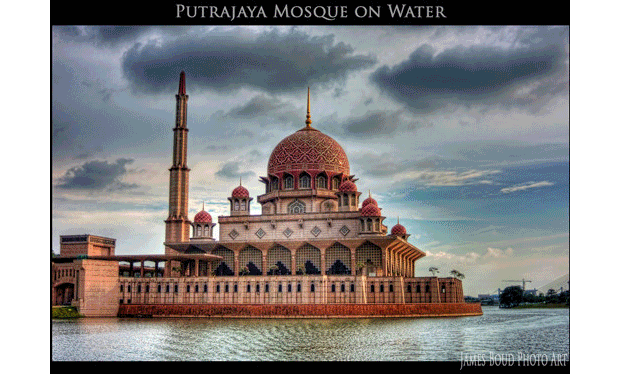
Putrajaya Mosque on Water – Malaysia
The Umayyad Mosque – Damascus
Ubudiah Mosque in Kuala Kangsar
Faisal Mosque – Pakistan
 

 Jame Asr Hassanil Bolkiah Mosque, Brunei


Jumeirah Grand Mosque, Dubai 


Saturday, 11 August 2012

Benefits of Using Miswak the Natural Toothpaste


Miswak is a twig that has been used since ages for oral hygiene. Studies show that miswak works better then a tooth paste. Muslims use it now as well as it is believed that the last Prophet used it.

A few important benefits of Miswak

* Miswak is used as an effective anti-bacterial for teeth, by kill gum diseases that cause bacteria formation. Thus keeps teeth healthy and safe. It kills a bacterium that causes periodontal disease.
* Another reason miswak is an effective oral hygienic element as it fights plaque with is natural comment.

* It effectively Fights against caries.

* While your teeth are healthy your mouth doesn’t smell bad. It has its natural fragrance that keeps your mouth sell good.

* It acts like a brush to. Brushes between the teeth as well and keeps them clean. It has parallel bristles to its stick. Therefore it not only acts a tooth brush or a tooth paste it also acts like floss.
* Miswak also Increases salivation and hence restrains dry mouth (Xerostomia).

* It is 20 times more effective than ordinary mint. Studies show that ordinary mint only kills 3.6% of bacteria while mint laced with miswak killed up to 60 % of bacteria.

It prevents gingivitis provided it is used correctly.


Beautiful Animals of Arctic

The Arctic is a very cold, windy, and often snowy biome located around the North Pole. When referring to the Arctic, people usually mean the part of the earth within the Arctic Circle (an imaginary circle around the Earth, parallel to the Equator and 23 degrees 28 minutes from the North Pole, that is, above about 75 degrees North Latitude). Although there is no land at the North Pole, the icy Arctic Ocean is teeming with life ranging from the microscopic (like zooplankton) to the huge (like whales). There is also a lot of land within the Arctic Circle (northern parts of Asia, Europe, and North America). Land within the Arctic Circle is tundra, and it supports less life most other biomes because of the cold temperatures, strong, dry winds, and permafrost (permanently-frozen soil). Long periods of darkness (in the winter) and light (in the summer) also affect Arctic life. Animals that live in the Arctic (either full time or seasonally) are adapted to extreme conditions. Many animals who overwinter in the Arctic (like the Arctic fox and the ermine) have a coat that thickens and changes color to white during the winter as camouflage in the snow (blending into the background is called cryptic coloration). Some animals hibernate during the cold season; they go into a very deep, sleep-like state in which their heartbeat slows down. These animals often hibernate in an underground burrow or pit. Some hibernators include skunks, chipmunks, and some bears (but these bears are not true hibernators, they go into a state that is closer to a normal deep sleep). Many animals (like the Arctic tern) spend the summer months in the Arctic, but leave as the weather turns frigid and food becomes scarce (these animals return again the next summer, repeating this pattern year after year). This behavior is called migrating.
The Alaskan malamute is a powerful sled dog from Alaska.


                                 This small, white fox lives farther north than any other land animal.
                                        This white hare lives in the Arctic and has huge hindfeet.
                A small bird that flies from the Arctic to the Antarctic and back again each year.
 

Arctic wolves are carnivores that live in Northern Canada.

                              A small, white, toothed whale that lives mostly in cold, Arctic waters

A wild, white sheep from the Arctic and sub-Arctic of North America.
Ermine also known as stoat or short-tailed weasel, this tiny, ferocious mammal lives in cold areas.


A large, slow-swimming shark with glow-in-the-dark eyes.


Harp Seals live are marine mammals that live in the North Atlantic and the Arctic Ocean.


Wednesday, 1 August 2012

The world’s most-visited ancient ruins


Believe it or not, ancient ruins are very popular among tourists. They are one of the few ways modern man can come into contact with the wonders of ancient technology and art and travel back to times long past. Here a look at the worlds most famous ancient ruins:


Great Wall, Badaling, China

With a name so simple, yet so powerful, the Great Wall stretches for 5,500 miles across China. Its most beautiful section is also easily accessible — within 70 miles of Beijing. While much of what is visible today was built during the Ming Dynasty (1368 to 1644), construction began on various sections as far back as 770 BC. Annual visitors: 9 to 10 million.

Terracotta Army, Xi’an, China

Discovered in 1974, these 700 life-size terracotta generals, infantrymen, archers and chariot drivers are each unique, with distinct facial features, hairstyles and clothing. The clay statues were arranged in rows in covered pits as part of a necropolis for Emperor Qin Shi Huang. More are believed to still be buried, but work on removing and restoring the soldiers has been halted until a way can to found to keep their bright paint from fading in the air. Annual visitors: 3.6 to 4.5 million.

Pyramids of Giza, Egypt

As one of the original Seven Wonders of the World and certainly the symbol of Egypt, the Pyramids have been venerated for 4,500 years. But how the ancient Egyptians built them is unknown, which adds to their intriguing appeal. The three major tombs for pharaohs that rest at this Unesco World Heritage Site are now surrounded on three sides by the pressures of Cairo, a city teeming with nearly 11 million people. Annual visitors: four million.

Roman Forum, Rome

The social centre of Rome for 1,200 years beginning in the 5th Century BC, this 700-yard-long piazza has been both a marketplace and a government centre. The ruins of sacred temples’ columns and friezes (whether dedicated to Saturn, the god of agriculture, or to the emperors Vespasian and Titus) hint at the Forum’s level of grandeur two millennia ago. Annual visitors: 5.1 million.

Colosseum, Rome

When completed in 80 AD, the arena held 50,000 spectators who watched mythical dramas, re-enactments of land and sea battles, executions, fights-to-the-death and the ghastly slaughter of wild animals. The underground pits where gladiators awaited their fates were opened to visitors in 2010, along with the 110ft-high upper ring of seats, which offer panoramic views of the Eternal City. Annual visitors: 6.9 million.


Believe it or not, ancient ruins are very popular among tourists. They are one of the few ways modern man can come into contact with the wonders of ancient technology and art and travel back to times long past. Here a look at the worlds most famous ancient ruins:


Great Wall, Badaling, China

With a name so simple, yet so powerful, the Great Wall stretches for 5,500 miles across China. Its most beautiful section is also easily accessible — within 70 miles of Beijing. While much of what is visible today was built during the Ming Dynasty (1368 to 1644), construction began on various sections as far back as 770 BC. Annual visitors: 9 to 10 million.

Terracotta Army, Xi’an, China

Discovered in 1974, these 700 life-size terracotta generals, infantrymen, archers and chariot drivers are each unique, with distinct facial features, hairstyles and clothing. The clay statues were arranged in rows in covered pits as part of a necropolis for Emperor Qin Shi Huang. More are believed to still be buried, but work on removing and restoring the soldiers has been halted until a way can to found to keep their bright paint from fading in the air. Annual visitors: 3.6 to 4.5 million.

Pyramids of Giza, Egypt

As one of the original Seven Wonders of the World and certainly the symbol of Egypt, the Pyramids have been venerated for 4,500 years. But how the ancient Egyptians built them is unknown, which adds to their intriguing appeal. The three major tombs for pharaohs that rest at this Unesco World Heritage Site are now surrounded on three sides by the pressures of Cairo, a city teeming with nearly 11 million people. Annual visitors: four million.

Roman Forum, Rome

The social centre of Rome for 1,200 years beginning in the 5th Century BC, this 700-yard-long piazza has been both a marketplace and a government centre. The ruins of sacred temples’ columns and friezes (whether dedicated to Saturn, the god of agriculture, or to the emperors Vespasian and Titus) hint at the Forum’s level of grandeur two millennia ago. Annual visitors: 5.1 million.

Colosseum, Rome

When completed in 80 AD, the arena held 50,000 spectators who watched mythical dramas, re-enactments of land and sea battles, executions, fights-to-the-death and the ghastly slaughter of wild animals. The underground pits where gladiators awaited their fates were opened to visitors in 2010, along with the 110ft-high upper ring of seats, which offer panoramic views of the Eternal City. Annual visitors: 6.9 million.

Monday, 30 July 2012

Russia denies plans for new navy bases abroad


Russia's Defence Ministry has denied reports Moscow its planning to set up its first new overseas navy bases since the 1991 collapse of the Soviet Union.
Earlier, a news agency quoted Russia's navy chief as saying that Cuba, Vietnam and the Seychelles were being considered as possible sites.

But the ministry said that Vice Adm Viktor Chirkov had never made the alleged remarks.

A lack of money after 1991 led to the closure of most Russian bases abroad.

It closed a base in Vietnam in 2002, and currently has bases only in Ukraine and Syria. President Vladimir Putin has pledged to restore Russia's military might.

In recent years, Moscow has expanded its navy's operations overseas, including by taking part in international anti-piracy operations near Somalia.

"It's true that we are continuing work on providing the navy with bases outside the Russian Federation," the RIA-Novosti news agency quoted Vice Adm Chirkov as saying in an interview.

According to the agency, he added that Moscow was "working out the issue of creating sites for material and technical support on the territory of Cuba, the Seychelles and Vietnam".

'Fantasy'
However, the defence ministry later insisted Vice Adm Chirkov had said no such thing, and that the subject had not been broached during the interview.

"Issues concerning international relations are not part of the responsibilities of the commander-in-chief of the navy," the ministry said in a statement posted on its website.

It added that the reported remarks were a "fantasy of their author, who preferred to prioritise sensationalism above competency and professional ethics".

In 2002, during Mr Putin's first term as president, Russia pulled out of the Cam Ranh base in Vietnam, opened in its then-communist ally at the height of the Cold War in 1979.

The closure came after the the original 25-year lease expired and Vietnam demanded a higher rent, but analysts say a desire to improve relations with the United States also played a role.

The country's remaining overseas bases are in Sevastopol, in Ukraine, where Russia's Black Sea Fleet is housed, as well as a small logistical support base in the Syrian port of Tartus.

Sunday, 29 July 2012

Boris Johnson chides Mitover London Olympicst Romney


The mayor of London has hit out at US presidential candidate Mitt Romney for comments suggesting Britain is not ready to stage the Olympic Games.

Boris Johnson fired up a large crowd in Hyde Park, saying: "There's a guy called Mitt Romney who wants to know whether we're ready. Are we ready?"

Earlier, Mr Romney backtracked after meeting UK PM David Cameron and predicted a "very successful" Olympics.

The Republican will take on Barack Obama in November's election.

Mr Romney's remarks came on the first official day of a week-long tour that is to include stops in Israel and Poland.
It is the first foreign visit Mr Romney is making as a presidential candidate and correspondents say his campaign is aiming to boost the foreign policy profile of the former governor of Massachusetts.
In the contest for the Republican nomination, Mr Romney made much of the fact that he delivered a successful Winter Olympics in Salt Lake City in 2002, when he was chief executive of the event.

Friday, 27 July 2012

Bo Xilai scandal: Gu Kailai charged with Heywood murder


The wife of disgraced Chinese political leader Bo Xilai has been charged with the murder of UK businessman Neil Heywood, state news agency Xinhua says.


Gu Kailai and Zhang Xiaojun, employed at Mr Bo's home, were "recently" prosecuted by a Chinese court, Xinhua said, without giving further details.

Mr Heywood was found dead in a hotel in Chongqing on 15 November 2011.

The apparent murder of Mr Heywood triggered Mr Bo's downfall in a scandal that has rocked Chinese politics


Local officials initially said Mr Heywood died of excessive drinking, but the government announced in April it was investigating Mr Bo's wife in connection with the case.

The two accused have been charged with intentional homicide by the Hefei Municipal Procuratorate (state prosecutor's office) in the eastern province of Anhui.

Britain welcomed the news, saying it was "glad to see" China is continuing the investigation into Mr Heywood's death.

Political influence?

The timing of the announcement is significant, as is the fact that Ms Gu is being prosecuted in Anhui, some distance from Chongqing, where the crime allegedly took place, says BBC Chinese.com editor Yuwen Wu.


Legal experts told BBC Chinese that authorities would have had concerns about the political influence Bo Xilai and his family may still exert in Chongqing and whether that would affect a fair trial.

Analysts also say the authorities are keen to resolve the case quickly before China undergoes its politically sensitive once-in-a-decade party leadership change at the Communist Party congress this autumn.

Users of China's Sina Weibo website - the equivalent of Twitter- were quick to express their shock at the abrupt announcement, but "Gu Kailai" remains a censored keyword.

A number of users criticised the timing of the report, alleging that the authorities wanted to divert attention from recent deadly floods in Beijing.


High-flyer
Investigators have concluded that Ms Gu and her son had conflicts with Mr Heywood over economic interests, and that worries about a possible threat posed by Mr Heywood to her son's personal security may have led Ms Gu, along with Mr Zhang, to poison Mr Heywood to death, according to Xinhua.

"The facts of the two defendants' crime are clear, and the evidence is irrefutable and substantial," said the agency's report, which was also read out on state television.

The exact nature of Mr Heywood's role and his relations with the Bo family are unclear, and have been the subject of much speculation inside and outside China. At the very least, there were close business contacts between the Bo family and Mr Heywood.

Mr Bo, the former high-flying leader of the south-western Chinese mega-city of Chongqing, was sacked in March and is under investigation for allegedly flouting Communist Party rules.

He made his name tackling corruption in the sprawling city of Chongqing and had been expected to be elected to an important position during this year's leadership change.

Mr Bo also implemented a drive to promote China's communist past, which included public performances of Mao-era songs in Chongqing. There have been claims that his anti-crime drive involved cases of torture.


One of China's most charismatic politicians, his status as the son of former party elder Bo Yibo made him one of the "princelings" of Chinese politics - a term used to describe the descendants of senior party figures in the early years of communist rule.
His downfall was triggered when his police chief, Wang Lijun, fled to the US consulate, reportedly to seek asylum after falling out with Mr Bo over his investigation into the death of Mr Heywood.

The Xinhua report about Ms Gu's prosecution made no reference to Mr Bo or any investigation into him.

Earlier this month, French architect Patrick Devillers, who is alleged to have links to Mr Bo and Ms Gu, was arrested in Cambodia before voluntarily flying to China. A Chinese official said he was wanted as a witness.

On Tuesday, he was reported to be in "good shape" after meeting French diplomats earlier in the week.

Businessman Neil Heywood died on 15 November in the Chinese city of Chongqing


Japanese women fall behind Hong Kong in longevity


Japanese women have fallen behind Hong Kong in global life expectancy rankings for the first time in 25 years.

This was partly due to the devastating earthquake and tsunami that hit the country in March 2011, said an annual report by Japan's health ministry.

The expected lifespan for Japanese women dropped from 86.30 years in 2010 to to 85.90 years in 2011.

The official life expectancy for women in Hong Kong last year was 86.70 years.

The March 2011 earthquake and tsunami contributed to pushing life expectancy figures down

Japan has topped the women's rankings for a quarter of a century, with longevity attributed in part to a healthy traditional diet.

The magnitude 9.0 earthquake and tsunami that left more than 20,000 dead or missing pushed the life expectancy down.

However the report noted that even without the disaster Japanese women would still have dropped behind Hong Kong in the statistics.

Other factors contributing to the dip included a rise in the number of suicides among Japanese women, disease and other natural death causes, the report said.
The life expectancy for men in Japan also declined from 79.55 in 2010 to 79.44 last year.
The men dropped from fourth place in 2010 to eighth last year in the global life expectancy ranking, said Japan's Kyodo news agency.


The white elephants that dragged Spain into the red


Europe has already bailed out Spanish banks, now Spain's regions are clamouring for money from central government - and one of the reasons for this is their lavish spending on white elephant building projects, such as the airport at Ciudad Real, south of Madrid.

It has one of the longest runways in Europe but today there are no planes, only hawks and falcons gliding in the still heat over the arid yellow landscape of Don Quixote's Castilla La Mancha.

Rabbits pop up around the state-of-the-art terminal, built of steel, glass and gleaming white concrete.

The airport of Ciudad Real opened in 2008 but it closed in April 2012. The luggage trolleys are now trussed together in the car park gathering dust and cobwebs.

It is not the only white elephant to stomp across Spain's landscape. It is merely one of the herd, a monument to the country's burst construction bubble which brought down its banks.

When a local construction magnate came up with the idea of an airport in Ciudad Real, money was sloshing around Spain for public works.

It was the 1990s and every town in every region had a grand project to set itself apart and bring in the visitors. Bilbao was getting its own Guggenheim museum, so why shouldn't Ciudad Real have its own airport?

"We had an attack of wealth, we didn't know how but suddenly we were rich," says Miguel Angel Bastenier, senior columnist at the left-of-centre daily El Pais. "There was such a frenzy for investing money and people got inebriated."

The airport in Ciudad Real was to be a private project, for private profit, but the business people behind it had no problem getting political support.

Before their collapse, Spain's local savings banks (the cajas), were different from other banks in one crucial way - local politicians sat on the board. So companies needed political support for large projects to encourage the cajas to invest.

Both the main political parties were in favour says Santiago Moreno, a spokesman for the socialist PSOE party which controlled the regional government at the time.

"Expert studies commissioned by the airport investors said it would create 6,000 jobs and a boom for the economy. There would have been a before and after for Ciudad Real."
But the airport opened its runways to a world in the worst recession for nearly 100 years. Caja Castilla La Mancha became the first of Spain's local savings banks to go under in the crisis, with a rumoured 70% stake in direct and indirect investment in the airport.

Many more of Spain's cajas have since had to merge or be taken over, exposed to toxic debts. Should they have been speculating on Spain's construction boom? The Bank of Spain has fined two of the politicians who sat on the board of Caja Castilla La Mancha for what it calls "serious violations".

"You might think the airport failed because of the crisis, but I am convinced that the shareholders never thought it (the airport) would work. The only profit in this airport was the building of it," says local investigative journalist Carlos Otto.

The official bankruptcy report for the airport seems to back this up. It says:

"The loans taken out were enough to cover the construction phase but no thought was given to the investment needed to make the airport function as a business."

Banks approached by the shareholders for further loans said they didn't think the business model for the airport was viable, the report says.

It goes on: "The construction itself of the airport provided the first profit for the investors because they signed contracts with their own construction companies."

"It was never run as a proper business," said a former worker at the airport who wanted to remain anonymous. He hasn't found another job and worries he won't get one in Ciudad Real - where everyone knows everyone - if he speaks out about how the airport was run.

"We had races on anything that had wheels," he told us. "We even had races on the floor-polishing machines - we were all so bored. Some people used to go out to pick asparagus or catch rabbits…"

There was little to do. There were international flights from London Stansted, and within Spain from Barcelona and Palma de Mallorca. But in its last year not even one flight a day landed on the 4.2km runway, designed - ambitiously - to service the new Airbus 380, the world's largest passenger airliner.


Residents of Ciudad Real demonstrate against the cuts
Carlos Otto believes the private investors who pushed the airport project assumed the regional government would ensure its profitability by subsidising airlines to fly there.

The regional government is now controlled by Spain's Popular Party which accuses its predecessor of wasting millions of euros. It is still not known how much the whole airport venture actually cost. Estimates run from 356 million euros to one billion euros.

This lack of transparency is one of the problems that led to Spain's economic crisis according to David Cabo, representative of Civio, a foundation that lobbies for freedom of information.

"Public servants are not used to being monitored, their accountability isn't common in Spain. It's terrible because you have many opaque layers of government and each of those control public money."

Continue reading the main story
Find out more

Listen to the full report on Radio 4's Crossing Continents on Monday, 30 July at 20:30 BST.

Or listen now via the Radio 4 website
Download the Crossing Continents podcast
Explore the Crossing Continents archive
Juan Jose Toribio, an economist with Spain's IESE business school, says that to tackle Spain's problem of white elephant projects you first have to tackle the country's sacred cows - the semi-autonomous regions.

"Regional governments enjoy the possibility of spending and inaugurating public works but they don't run the political risk or cost of raising taxes. Someone should be held responsible for this and perhaps we should return to a much more centralised system."

But even with an absolute majority in parliament, the Popular Party may find centralisation harder to achieve than austerity.

At Cruz Prado school in Ciudad Real, daily drop-off resembles a picket line, with parents letting off fire-crackers and shouting through loud-hailers. They are demonstrating against the local government for failing to finish construction of a new canteen and playground. For the last two years the project has remained a wreck of rubble - stalled because the money has run out for the next generation.

One of the parents, Milagros Coronado, says she feels angry - and guilty.

"I shouldn't because it wasn't my decision to build the airport, but I feel guilty for having liked the idea so much. I would like to have an airport, I would like to have everything, but I definitely, definitely need a proper school for my children."

From the central square of the village of Ballesteros de Calatrava, you can see the airport. During the building of it, the now-deserted streets here were abuzz with expectation - people thought this huge project would bring jobs and a better life. Carmen Delgado, who lives here, says people were pressured to sell their land, and some of her family's fields were expropriated for the airport.

"Land is everything for us. If you have land you can have potatoes, tomatoes, animals, olives to make oil... And now? We've been robbed of our way of life, and for what?"
.


Thursday, 26 July 2012

Redwoods and Wine Tour


Join us on this tour and combine the beauty of the Redwood forest with a fun and educational visit to Sonoma wine country. Today’s tour begins with a pick up at your hotel in San Francisco in our comfortable 14- passenger van. Our tour then heads across the Golden Gate bridge into beautiful Marin County. We then head to Muir Woods National Monument where you will have ample time to stroll through the Coastal Redwood Forest and take in the beauty and majesty of these breath-taking trees. Our expert guides will gladly share fascinating facts about these incredible giants.

From the Redwoods, we head to the vineyards and tasting rooms of Sonoma County.  We will enjoy the bounty of the Carneros region of Sonoma at tasting rooms with sweeping views of the valley. After that, we'll head to the historic town of Sonoma where you will have the opportunity to visit the Sonoma Mission and Barracks, shop at the boutiques, continue wine tasting, or visit some of the best art and photography galleries found in Northern California.

After enjoying lunch at one of Sonoma’s many restaurants, we will continue our visits to the wineries with a stop at Cline cellars. One of the first wineries on the road to wine country, this historic property was once the site of a Miwok Village and the first camp of the Sonoma Mission. Their tasting room is located in an 1850s farmhouse and surrounded by lush gardens and ponds.

Our last visit will take us to Jacuzzi vineyards and Olive Press. Here you will have the opportunity to taste their wines along with their award winning olive oils. The Olive Press Olive Oil Tasting Room and Gift Shop in Sonoma, California, is dedicated to anything and everything having to do with olives and olive oil. You’ll find many unique and distinctive items for gift giving and for your own home.

From here we’ll head back towards San Francisco where you'll have the opportunity to end your day with a ferry ride from Sausalito to San Francisco.  If you'd like to enjoy dinner and a stroll in the charming town of Sausalito, you are more than welcome to take a later ferry!

Daily Tour Times
8:00-6:00pm

Tour Prices*
Adults $85
Children $65

San Francisco


San Francisco City Tour

Avoid the big bus tours and come along on an insider’s journey around San Francisco with Explore California. This tour will show you the highlights and hidden gems of the most beautiful city in the United States. All of our tours are lead by San Francisco locals who will share with you their personal anecdotes of living in San Francisco and give you some insight on what it's like to live in such a spectacular place.

The tour begins with a pickup at your hotel in San Francisco in our comfortable 14-passenger van. On this tour you will visit the Financial District, Potrero Hill, the Mission, Castro, Twin Peaks, Haight Ashbury, Golden Gate Park, Ocean Beach, Presidio, Pacific Heights, Marina, Fisherman’s Wharf, Chinatown, and Union Square. We know the best places to stop and take photos along the way, so make sure to bring those cameras along. This is a great tour for the first time visitor to SF or for someone wanting to take visitors around the city without having to deal with driving their own vehicle.

If you have already spent some time in S.F., we are happy to customize our tour to some off-the-beaten path neighborhoods and integrate food and culture.  We will make sure that if you've been here 20 times, you will see something new and different

Sunday, 22 July 2012

Spanish WWF sacks King Juan Carlos over elephant hunt


The conservation group WWF in Spain has removed King Juan Carlos as its honorary president for going on an elephant hunting trip in Botswana.
The WWF's Spanish chapter voted overwhelmingly to abolish the post, a statement said, adding that the safari did not sit well with WWF goals. 

The king was widely criticised after news of the trip emerged in April, in the middle of a severe economic crisis.

Spain's royal family has faced a series of embarrassments this year.

King Juan Carlos apologised to the Spanish people for the hunting trip, which only came to light when he was flown home from Africa after breaking a hip.

An online petition calling for his resignation from the WWF post accumulated almost 85,000 signatures by the time he made his public apology.

'Incompatible'
The controversy prompted Spanish newspapers to publish a photo of the king on a previous safari, in which he is seen standing with a gun beside a dead elephant.

"Although this type of hunting is legal and regulated, many members consider it to be incompatible with the position of honorary patron of an international organisation that aims to protect the environment," the WWF statement said on Saturday.

The vote to abolish the position of honorary president was carried by a 94% majority, it said.

The king is generally popular in Spain, but the royal family has been beset by a series of embarrassing news stories this year.

The king's son-in-law, Inaki Urdangarin, has been questioned in connection with a corruption scandal involving claims that he used public funds to organise sports events.

US man reunited with long-lost, stolen Austin-Healey


 Mr Russell and his wife were reunited with his prize
A US man has recovered a vintage sports car he spotted being sold on eBay 42 years after thieves stole it from him, officials in California say.

Robert Russell, 66, said he had never given up searching for the 1967 Austin-Healey, which was stolen in 1970.

After seeing the car on eBay, he found that the vehicle identification number on the website matched the one on his title certificate, AP reports.

The car was being put up for auction by a dealer in Los Angeles.

The dealer told Mr Russell they had bought it from a man who said it had been in his family since 1970.

After checking Mr Russell's claim, the Los Angeles County Sheriff's Department told him he could pick up his vehicle.

He has since brought it back to Texas where he currently lives, AP says.

Mr Russell told police he had originally bought the vehicle for $3,000 (£1,925). It is now valued at $23,000

A US man has recovered a vintage sports car he spotted being sold on eBay 42 years after thieves stole it from him, officials in California say.

Robert Russell, 66, said he had never given up searching for the 1967 Austin-Healey, which was stolen in 1970.

After seeing the car on eBay, he found that the vehicle identification number on the website matched the one on his title certificate, AP reports.

The car was being put up for auction by a dealer in Los Angeles.

The dealer told Mr Russell they had bought it from a man who said it had been in his family since 1970.

After checking Mr Russell's claim, the Los Angeles County Sheriff's Department told him he could pick up his vehicle.

He has since brought it back to Texas where he currently lives, AP says.

Mr Russell told police he had originally bought the vehicle for $3,000 (£1,925). It is now valued at $23,000

World Most Beautiful Train Stations


These are some of the most beautifull and incredible train stations in the world. Some of them look like museums while others are modern and beautiful. If you missed your train these incredible train stations would probably make your wait more barable.
          Atocha Train Station - Madrid, Spain
Rossio Station - Lisbon, Portugal


Sirkeci Station - Istanbul, Turkey
King’s Cross Station - London, England
Union Station - Los Angeles, California

Grand Central Station - New York City, New York

Gare du Nord — Paris, France - Paris, France